
Commercial Mortgages.
Demystified.
Commercial lending has its own language, its own metrics and its own logic. This course breaks all of it down — so you can bring commercial deals to the table with the analysis and confidence that lenders expect.
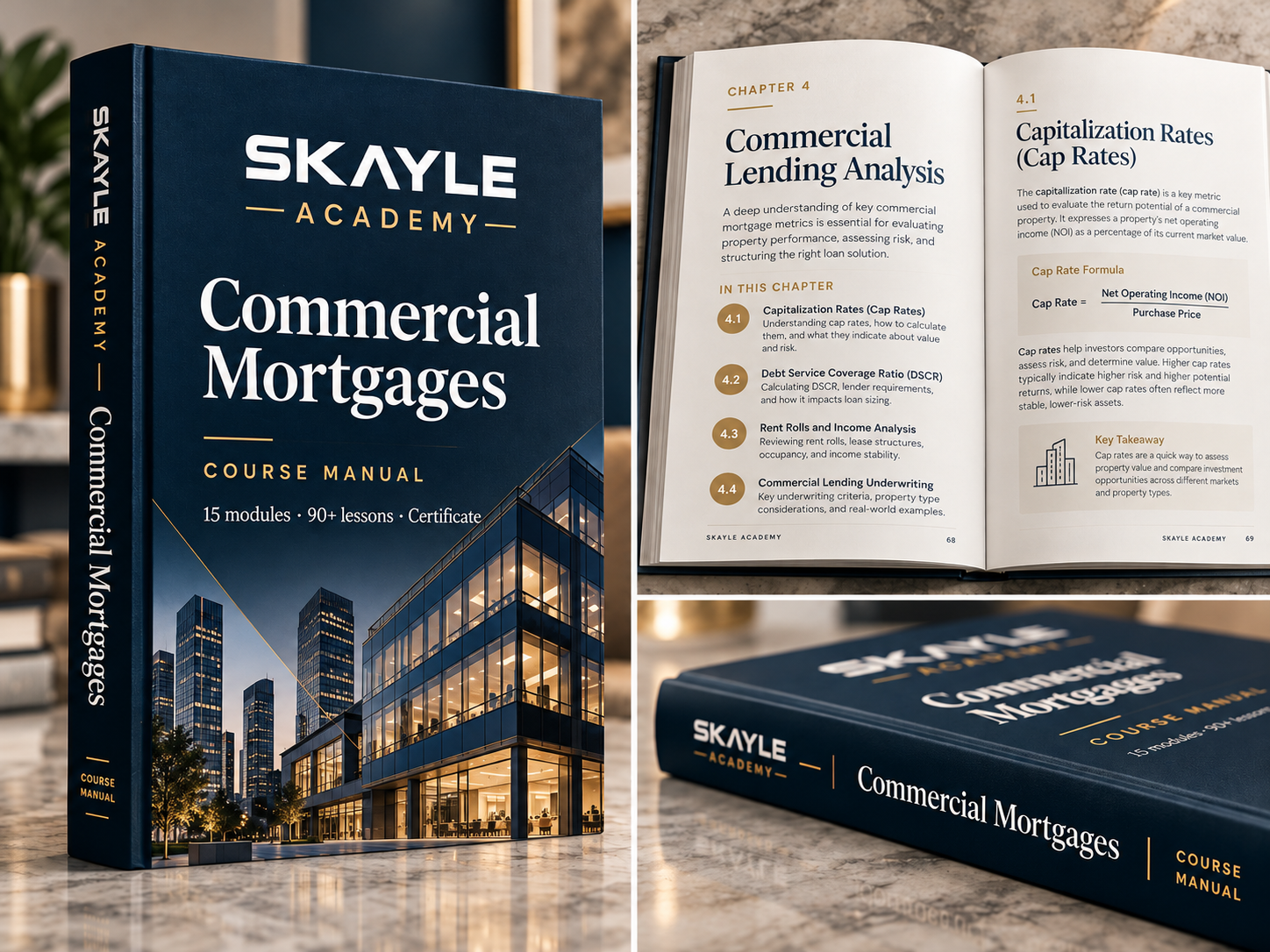
Developed by top Canadian mortgage professionals. Content is reviewed and updated to reflect current lender guidelines, OSFI regulations and provincial requirements. Used by mortgage agents, underwriters and brokers across Canada.
Three ways this course expands your commercial expertise.
Read the numbers
Net operating income, capitalization rates, debt service coverage ratios, rent rolls — you'll understand the metrics that drive every commercial lending decision, calculate them accurately and use them to evaluate any deal.
Analyze any property type
Office, retail, industrial, multi-family, mixed-use — learn how lenders evaluate each one differently. Understand what drives value, what creates risk and what separates a strong commercial application from a weak one.
Build commercial confidence
Bring commercial deals to the table with the analysis, terminology and deal structure that institutional lenders expect. Represent your clients at a higher level — and win more commercial business because of it.
15 modules. The full commercial mortgage picture.
From commercial underwriting fundamentals to deal structuring, construction financing and practical case studies — this is the most comprehensive commercial mortgage education available to Canadian professionals.
- How commercial mortgages differ from residential
- Commercial lenders: banks, credit unions, life cos, CMHC, private
- The underwriting mindset in commercial lending
- Typical commercial mortgage terms, amortizations and structures
- Recourse vs. non-recourse lending
- Multi-family residential: small and large apartment buildings
- Office properties: Class A, B and C characteristics
- Retail: strip malls, anchored vs. unanchored, single tenant
- Industrial: warehouses, flex, distribution centres
- Mixed-use properties and the challenges they create
- Special-purpose properties and their lending limitations
- How lenders categorize and price risk by property type
- Assessing the sponsor: personal financial strength and track record
- Corporate vs. personal borrower structures
- Reading commercial financial statements
- Business income and personal income in the same deal
- Experience requirements for commercial borrowers
- Guarantees and what lenders require from principals
- The three approaches to commercial valuation
- Income approach: applying the cap rate method
- Cost approach and sales comparison in commercial contexts
- How lenders use AACI appraisals
- When and why lender value differs from market value
- Environmental assessments and their impact on valuation
- What NOI is and why it drives every income property decision
- Calculating gross income, vacancy allowances and operating expenses
- Above-the-line vs. below-the-line expenses
- How to normalize NOI from a borrower's financials
- Common errors in NOI presentation and how to correct them
- What DSCR measures and why lenders require a minimum
- Calculating DSCR from property income and loan payments
- Typical DSCR minimums by lender type and property category
- How DSCR interacts with LTV in deal sizing
- When a deal is constrained by DSCR vs. LTV
- What a cap rate is and what drives it
- How cap rates vary by property type, market and condition
- Using cap rates to determine property value
- The relationship between cap rates and interest rates
- Reading market cap rate data and applying it to a specific deal
- Reading a commercial rent roll
- Lease types: gross, net, double net, triple net
- Tenant quality: anchor tenants vs. credit tenants vs. local tenants
- Lease expiry concentration risk
- How above-market and below-market rents affect value
- Vacancy, absorption and the market rent reality
- What a commercial appraisal contains and how lenders use it
- Review appraisal vs. full AACI: when each is required
- Challenging an appraisal: when it's appropriate and how to do it
- Environmental liability: Phase 1, Phase 2 and their impact on lending
- Reading an income statement in a commercial lending context
- Reading a balance sheet for borrower strength
- How lenders use notice-to-reader vs. review vs. audit financials
- Adjustments and add-backs for owner-operated businesses
- Personal guarantor net worth assessments
- When the business income matters and when it doesn't
- Information required in a complete commercial mortgage submission
- Writing an effective executive summary for a commercial deal
- Presenting income properties to institutional lenders
- Presenting commercial deals to life insurance companies and CMHC
- What makes a commercial submission stand out — and what kills it
- Multi-family: CMHC MLI programs and conventional alternatives
- Office and retail: how vacancy assumptions shape the deal
- Industrial: leasehold improvements and environmental risk
- Mixed-use: how lenders weight residential vs. commercial income
- Special-purpose: land value, restricted use and the lending ceiling
- Sizing a commercial loan: income-based vs. value-based constraints
- First mortgage, second mortgage and mezzanine structures
- Interest-only periods: when and why they're used
- Syndicated mortgages: structure and investor considerations
- Vendor take-back mortgages in commercial transactions
- Balancing DSCR, LTV and client objectives in one deal
- How construction loans differ from term mortgages
- Cost-to-complete analysis and draw schedule basics
- Lender requirements: pro forma, permits, contracts and insurance
- CMHC MLI Select for new construction multi-family
- Risk factors in construction financing: delays, cost overruns, pre-sales
- Take-out financing: planning the end from the beginning
- Case study: 12-unit apartment acquisition financing
- Case study: strip mall with mixed tenancy
- Case study: industrial property with environmental concern
- Case study: office building with high vacancy
- Case study: mixed-use building with retail and residential
- Case study: new construction multi-family financing
- Final practical review: complete commercial deal analysis
For professionals ready to enter — or advance in — commercial lending.
This course is for mortgage professionals, underwriters and industry participants who want to understand commercial mortgage lending at the level lenders expect.
Add commercial to your practice. Open a segment of the market that most residential agents never touch — and earn significantly larger deal fees.
Deepen your analytical skills and accelerate your advancement within a commercial lending team at a bank, credit union or life company.
Understand the exact criteria lenders use to evaluate income properties — and structure your deals to qualify before you approach a lender.
Transition your underwriting expertise into the commercial space with a clear, structured foundation in commercial credit analysis.

Zubair Afzal — Principal Broker with 20+ years in the field.
Zubair Afzal is a Principal Broker and one of Canada's top-producing mortgage professionals. His experience spans residential, alternative, private and commercial lending — and this course draws directly from hundreds of real commercial files he has structured and closed.
Every module reflects the systematic thinking that experienced commercial lenders use every day — not theory, not guidelines paraphrase.
"I've been doing residential mortgages for eight years. This course gave me the foundation I needed to start taking on commercial deals. The NOI and DSCR modules alone are worth it."
Mortgage BrokerOntario
"I work at a credit union and this course gave me a better commercial foundation than anything I received internally. The case studies are the real standout — actual files, actual decisions."
Commercial Credit AnalystAlberta
"The cap rate and rent roll modules finally made commercial property valuation click for me. I've taken other courses that danced around this. Skayle Academy just explains it."
Mortgage AgentBritish Columbia
Commercial Mortgages.
Conquered.
Commercial lending is where the biggest deals — and the most significant professional growth — happen. Enrol now and our team will confirm your enrolment within one business day.
- 15 modules, 90+ lessons
- Real-world Canadian commercial case studies
- Certificate of completion
- In-person, Mon–Fri 10AM–4PM
- Lifetime access to course materials
Our team will confirm your enrolment and send all details within one business day.
Get started in three steps.
Enrol now
Reserve your spot below. Our team confirms your enrolment and sends you everything you need before your class starts.
Attend your class week
Join your class Monday–Friday, 10AM–4PM. Your instructor works through every module with you. Bring your laptop.
Complete and earn your certificate
Show up every day, put in the work, and earn your Skayle Academy Certificate of Completion — ready to add to your LinkedIn profile.
Frequently asked questions
Everything you need to know about the Commercial Mortgage course.
Do I need a commercial background to take this course?
No. This course is designed for residential mortgage agents who want to add commercial to their expertise, as well as newer practitioners entering commercial lending. We start with the fundamentals — property types, income-based lending, NOI — before moving to complex deal analysis.
What types of commercial properties does the course cover?
We cover multi-residential (apartment buildings), office, retail, industrial, mixed-use, and development/construction financing. Each property type has a distinct lender approach and risk profile — understanding those differences is central to the course.
Will I learn how to calculate NOI and DSCR?
Yes — in depth. Net Operating Income and Debt Service Coverage Ratio are the two most critical metrics in commercial mortgage qualification, and we work through multiple real Canadian deal examples to make sure you can calculate and interpret them confidently.
How long is the course?
One intensive week: Monday to Friday, 10AM–4PM. Classes run twice per month at our Toronto location. Bring your laptop.
How is commercial underwriting different from residential?
Residential lending is primarily income-based — lenders qualify the borrower. Commercial lending is primarily property-based — lenders qualify the asset. The income from the property, its market cap rate, and the exit strategy all matter more than the borrower's personal income ratios. This shift in thinking is exactly what the course teaches.
Is a certificate included?
Yes. All graduates receive a Skayle Academy Commercial Mortgage certificate of completion. Given the complexity of commercial lending, this certification carries real weight with brokerages and employer lenders who are looking for agents with demonstrated commercial knowledge.
Still have a question?
We're happy to talk through whether this course is the right fit before you reserve your spot.
Commercial deals are where
the biggest growth happens.
Enrol now and get started. Our team is ready to confirm your enrolment.
Related reading
Go deeper on the topics covered in this course.
NOI and DSCR for commercial mortgages
Understand the two ratios lenders use to qualify every commercial deal.
What is a cap rate? A mortgage agent's guide
How cap rates affect valuation, pricing, and what lenders will fund.
Commercial property appraisals explained
How commercial appraisals work and why they differ from residential.
How to read a rent roll for a commercial deal
The rent roll is the income story — here is how to analyze it like a lender.
Mixed-use property mortgages in Canada
How lenders treat retail-plus-residential and the underwriting quirks to know.
Want personal guidance
beyond the course?
The Private Mortgage Mentorship is Skayle Academy's one-on-one program — 12 months of direct access to a Canadian principal broker. Built around your goals, your deals and where you want to go. Limited spots available.